LogBook
An enterprise academic LMS & educator workspace rebuilt from legacy PHP into a high-concurrency Go modular monolith backend on Microsoft Azure.
title: "LogBook: Enterprise Academic LMS & Educator Workspace" excerpt: "How a 194-feature legacy PHP system evolved into a high-concurrency Go modular monolith backend deployed on Azure with a Next.js frontend." date: "Dec 2025 - Present" stage: "production" readTime: "9 min read" stack: ["Go (Golang)", "Next.js", "TypeScript", "PostgreSQL", "Microsoft Azure", "Chi Router", "JWT"] role: "Lead Systems Architect & Full-Stack Developer" liveUrl: "https://logbook.syedsystems.dev"
LogBook — Enterprise Architecture & Product Evolution
Architecture Overview: Designed as a multi-tenant, white-label Learning Management System (LMS) and educator workspace for university faculties. Features a high-performance Go (Golang 1.26+) modular monolith backend deployed on Microsoft Azure, paired with a Next.js 14 / TypeScript frontend.
1. What Problem Does LogBook Solve?
Academic administrative operations at universities are notoriously complex and resource-intensive:
- Legacy Performance Bottlenecks: Traditional PHP/Moodle institutional portals crumble under concurrent user spikes during exam weeks or registration windows, consuming massive server RAM and CPU.
- Complex Academic Workflows: Higher education requires strict compliance with BAETE / OBE (Outcome-Based Education) criteria, program outcomes (POs), course outcomes (COs), multi-section class routines, and grade scheme evaluations.
- Weak Institutional Connectivity: Universities often operate on constrained internal networks or poor internet infrastructure, causing slow page loads and dropped requests when handling heavy data exports.
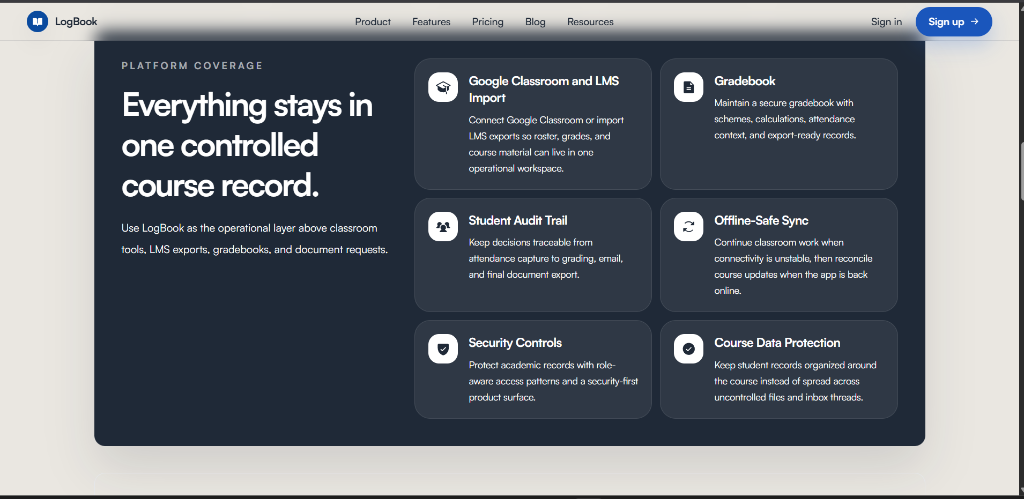
LogBook solves this by providing a unified, high-concurrency platform that automates attendance tracking, gradebook math, course routine scheduling, Google Classroom sync, and OBE reporting with minimal server overhead.
2. Societal Impact, User Count, & Product Positioning
Product Positioning
LogBook is positioned as an Enterprise Educator Workspace & Institution LMS. It is engineered for dual deployment:
- Multi-Tenant SaaS Cloud: Multi-tenant architecture (
org_idisolation) hosted on Microsoft Azure for cloud-based university subscriptions. - Single Binary On-Premise: Can be compiled into a single ~17MB executable for on-premise deployment on air-gapped university servers.
Impact & Benefits
- For Professors & Faculty: Zero operational friction. They get an intuitive, fast Next.js workspace for grade entry, roster management, and routine tracking without caring about underlying server complexity.
- For Universities: Saves thousands of dollars in server infrastructure costs while ensuring zero downtime during peak grading periods.
- For Students: Seamless login with Google Classroom integration and transparent academic tracking.
3. Tech Stack
- Backend: Go 1.26+ (Modular Monolith)
go-chi/chi/v5(Lightweight idiomatic HTTP router)jackc/pgx/v5(High-performance PostgreSQL connection pool)golang-jwt/jwt/v5(Stateless JWT authentication)rs/zerolog(Structured JSON logging)
- Frontend: Next.js 14 (App Router), TypeScript, TailwindCSS
- Database: PostgreSQL (with
org_idmulti-tenancy and optimized indexes) - Cloud & Hosting: Microsoft Azure (utilizing Azure student license credits for zero-cost high-performance hosting)
4. Tech Stack Justification & Product Evolution
The Evolution: PHP/Moodle → Next.js BaaS → Go Modular Monolith
- Phase 1 (Legacy PHP/Moodle): The original legacy system (
LogBook Institute) contained 190+ features, but suffered from terrible concurrency and speed under load. PHP-FPM required heavy server resources (Nginx/Apache + PHP workers), crashing under peak faculty load. - Phase 2 (Next.js/Supabase BaaS Experiment): We experimented with a TypeScript/Supabase stack (
Logbook V1.1). While great for rapid prototyping, relying entirely on serverless functions and client-side BaaS wrappers created execution limits for heavy backend data processing. - Phase 3 (Current Production - Go + Next.js): We made the strategic architectural decision to rewrite the backend in Go (Golang).
Why Go for Backend? (The Developer & Architect Perspective)
- Unmatched Concurrency & Low Resource Usage: Go compiles down to a tiny ~17MB single binary. Go's goroutines handle thousands of concurrent API requests using minimal RAM (a few megabytes) and CPU, compared to hundreds of megabytes required by Node.js or PHP processes.
- Resilience Under Low Bandwidth: In educational institutions with weak or spotty internet, Go's high-speed data processing ensures requests are served in milliseconds, preventing timeout errors under congested network conditions.
- Azure Cloud Cost Efficiency: From a developer and founder perspective, Go's ultra-low resource footprint allows hosting the entire production backend on Microsoft Azure using Azure student license credits. It delivers enterprise-grade performance without breaking the bank.
5. Future Plan & Strategic Roadmap
- Pilot University Rollout: Onboarding the first pilot university customer onto the Go + Azure infrastructure.
- BAETE / OBE Automated Analytics: Expanding outcome-based education mapping (PO/CO attainment charts) to provide automated institutional accreditation reports.
- Hybrid Sync: Enabling instantaneous sync between on-premise local campus installations and the Microsoft Azure cloud SaaS.